




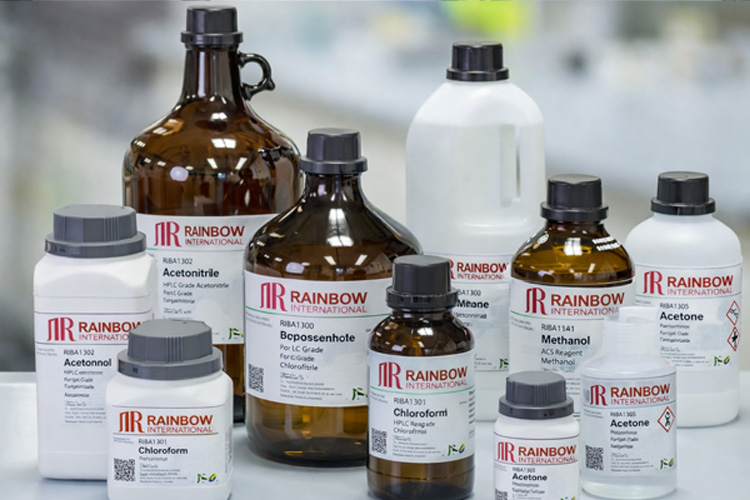
Laboratory & Analytical Reagents
Chemicals form the foundation of laboratory operations, playing a vital role in the manufacturing, analysis, and testing of nearly all pharmaceutical products.
Acids & Solvents
Acids and chemical solvents play a critical role in a wide range of chemical assays, analytical tests, and industrial reactions, in addition to their application as effective cleaning agents, such as sulphuric acid. Strong mineral acids, particularly in high concentrations, are highly corrosive and therefore require careful handling, appropriate safety measures, and controlled storage conditions. Chemical solvents are primarily hydrocarbons containing various functional groups, including alkanes (e.g., hexane), alcohols (e.g., butanol), and aromatic compounds (e.g., benzene and its derivatives). These solvents are extensively used across chemical, pharmaceutical, manufacturing, and laboratory environments, where they function mainly as dissolving media for a wide variety of solutes.
Most acids and solvents are highly flammable and hazardous, necessitating storage in certified fire-safety cabinets or equivalent protective systems. Direct exposure can pose significant risks to human health, making strict adherence to safety protocols essential. This category of chemicals encompasses a broad portfolio of acids and solvents used in applications such as batteries, antifreeze solutions, wood coatings, and paints. Additionally, it includes a wide range of substances utilized as refrigerants, fumigants, adhesives, laminates, coatings, and moulding compounds, catering to diverse industrial and laboratory requirements.
Generally, chemicals can be graded based on various standards. You will get confused if we explain each of them here. So we will understand only those which are commonly used in the domain.
The below-mentioned ones are classified based on their purity.
Technical Grade Chemicals: You may know this as TG (Tech Grade) or Commercial Grade. It is used for low-grade applications like commercial or industrial purposes. Due to the present impurities, it isn’t utilized for drug, food, or medicinal purposes. You can also find it in qualitative testing.
Synthesis Grade Chemicals: The primary purpose of this involves organic synthesis and preparative tasks.
Lab Grade Chemicals: These are commonly called UNILAB, Laboratory Reagent (LR Grade chemicals), or Chemically Pure (CP). You can find them in educational or teaching labs. Though their purity levels are high, the precise impurity levels remain anonymous.
Just like technical grade, their purity isn’t sufficient to use them for any drug, food, or medicinal applications. However, they may be utilized in work that doesn’t require analytical reagents.
AR grade Chemicals: These are used for high precision work. In this, trace impurities are restricted to the lowest possible limits for high precision. Such reagents get used mainly for analytical applications, research, and quality control. If such reagents meet the specifications of the American Chemical Society Committee on Analytical Reagents, it will be denoted as AR (ACS).
ACS Grade Chemicals: These reagents either meet or exceed all the standards stated by the American Chemical Society (ACS). Their purity levels are exceptionally high, and they are used in every domain wherever quality factor can’t be ignored. So you can easily find them in drug, food, or medical applications because they have above 95% purity.
General Reagent (GR) – These are the reagent that meets or exceed AR grade specifications.
Extra Pure Grade Chemicals: These are – suitable for laboratory accreditations and also work requiring compliance with pharmacopoeial standard requirements.
We can also classify the chemicals based on their applications. Let’s see a few examples.
Electronic Grade Chemicals: – these have very stringent limits for metallic impurities as required for use in electronic component industry as such as below ppt or ppb levels
HPLC Grade Chemicals: These include adequately pure ion-pair reagents, solvents, and buffers used as the mobile phase of High-Performance Liquid Chromatography (HPLC).
They meet strict UV absorbance specifications and are filtered for removal of sub-micron suspended solids. Plus, they can be available in different purification degrees as per the HPLC requirements. The only thing here is that the impurities in the reagent should not interfere with the HPLC analysis.
Spectroscopy Grade Chemicals: Various compounds are gained through organic synthesis. Nuclear magnetic resonance spectroscopy is the technique used for their structural analysis.
This process requires spectroscopy grade that includes solvents of high purity, low residue on boiling, and having absorption blank in the wavelength region of interest.
There is also an HPLC/spectroscopy grade for common use in HPLC and spectroscopic applications. Spectroscopy grade salts consist of alkali metal salts having transparency in the IR region such as KBr, NaCl, CsI, etc.
Acids are graded differently. You can see a few examples of it.
Suprapur (E – Merck) – These have high purity grade acids having metallic impurities in ppb range.
Environmental Grade (Anachemia) – These include high purity acids refined through sub- boiling distillation
Environmental Grade Plus (Anachemia) – Here, you can find acids that get produced by additional distillation of environmental grade acids.
Pesticide residue analysis applications
HR Omni Grade Solvents (EMD) – These have GC impurities below ppt/ppb levels as tested by ECD detection.
Nano Grade – These meet ACS grade specifications. They are used for extraction and pre-concentration applications.
Residue Grade Solvents – These solvents suitable for pesticide residue analysis.